Has strong-typed properties to read and write settings in storage
Implements INotifyPropertyChanged so you can bind to it in XAML
Raises an event when setting value changes
Quickstart
Install NickJohn.WinUI.ObservableSettings from Nuget.
Say you want to store a Volume as double in storage, with the default value 0.75.
All you need to do is adding an [ObservableSetting] attribute to the default value field:
usingNickJohn.WinUI.ObservableSettings;
...public partial classSettingsService// Don't forget to add "partial" keyword to the class!{[ObservableSetting("Volume")]// The "Volume" here is the key of the setting in storageprivatereadonlydoublevolume=0.75;// This field is used as the default setting value}
It will generate a partial class:
publicpartialclassSettingsService:INotifyPropertyChanged{// You can bind to "Volume" in XAMLpubliceventPropertyChangedEventHandler?PropertyChanged;// When the setting "Volume" changes, this event will be raisedpubliceventEventHandler<SettingValueChangedEventArgs<double>>?VolumeChanged;// Strong typed "Volume" property to read and write setting in storagepublicdoubleVolume{get{ ...}// Read setting from storageset{ ...}// Write setting to storage}}
Now you can use the generated class to read and write settings:
SettingsServicesettingsService=newSettingsService();// Handle setting value changed eventssettingsService.VolumeChanged+=(s,e)=>{Debug.WriteLine($"Volume changed from {e.OldValue} to {e.NewValue}");}Volumevolume=settingsService.Volume;// Read settings from storagevolume=volume/2;settingsService.Volume= volume // Write settings to storage
If you don’t, the Pascal form of the attributed field name will be used (same as the generated property name).
[ObservableSetting]// Setting key is "UserEmail"privatereadonlystringuserEmail= "";
⚠ But if you don’t provide an explicit settingKey, when you renames the attributed field, the setting key will change, and the saved setting will not be read correctly!
How are the settings stored?
Some types can be directly stored in Windows.Storage.ApplicationData.Current.LocalSettings.
If the type of the setting to save is one of these “native” setting types, it will be directly stored in storage.
Otherwise, it will be serialized as JSON with System.Text.Json and saved as string.
Welcome to HQ20 create-hq20-dapp. With a couple of different templates from a basic setup for smart contracts development, a react webui and an api with cache server. This is great for every new project. Contains examples of tests, coverage, documentation generators, linters, etc.
Quick Overview
npx create-hq20-dapp my-app
cd my-app
npm start
The following templates are available:
smart-contracts an example of a solidity smart contracts project
react-webui using a create-react-app boilerplate with typescript and ethers.js connecting to a local network
api an api with a cache server built with express.js and postgresql database, listening and caching events.
Usage
You’ll need to have Node 8.16.0 or Node 10.16.0 or later version on your local development machine (but it’s not required on the server). You can use nvm (macOS/Linux) or nvm-windows to switch Node versions between different projects.
It will create a directory called my-app inside the current folder.
Inside that directory, it will generate the initial project structure and install the transitive dependencies:
No configuration or complicated folder structures, only the files you need to build your app.
Once the installation is done, you can open your project folder:
cd my-app
Inside the newly created project, you can run some built-in commands:
This is a step-by-step on how to get all the workspaces working, but of course, you might not want to run the android app, so, no need to install the dependencies on that workspace. Or, you might not want to start the cache server, so you can ignore steps 3, 5 and 6. That’s up to you what to run. But whatever that is, it must be it the order shown above.
Repository updates
This repository has automatic updates, thanks to dependabot, with an exception to react-webui template. We choose to only allow to update react-scripts and security issues, with no automatic merges because that template highly relies on CRA.
Contributing
Pull requests are welcome. For major changes, please open an issue first to discuss what you would like to change.
Django models and helpers for integrating Paddle.com subscriptions with your Django app
⚠️This library is very much WORK IN PROGRESS, please read this document carefully to understand what is currently supported.
Currently this package includes:
Django Models for plans, plan prices, subscriptions, payments (invoices)
Django management commands for sycing plans, subscriptions, payments
Webhook receivers that handle subscription creation, subscription cancellation
Installation
Requires:
Python 3.6+
Django 2.1.0+
Install the django-paddle package
pip install django-paddle
Add django_paddle to your INSTALLED_APPS
INSTALLED_APPS= [
# ...'django_paddle',
# ...
]
In your settings.py add the following settings:
PADDLE_VENDOR_ID='your-vendor-id-here'# https://vendors.paddle.com/authenticationPADDLE_AUTH_CODE='your-auth-code-here'# https://vendors.paddle.com/authenticationPADDLE_PUBLIC_KEY="""-----BEGIN PUBLIC KEY-----yourpublickeyhere-----END PUBLIC KEY-----"""# https://vendors.paddle.com/public-keyPADDLE_ACCOUNT_MODEL='auth.User'
ℹ️ If you are using the default Django User model, set PADDLE_ACCOUNT_MODEL to auth.User. If you are using a custom User model set this to something like your_custom_app.YourUserModel.
In your projects main urls.py add the django_paddle URLs for receiving webhooks:
ℹ️ This will result in an absolute webhook URL https://example.com/webhook. Make sure this is the Webhook URL you set in your Paddle settings (https://vendors.paddle.com/alerts-webhooks).
Run migrations
python manage.py migrate
The User Model specified in PADDLE_ACCOUNT_MODEL will now have a back-reference to the PaddleSubscription and vice versa.
We need a shared identifier between the User model and the PaddleSubscription model. This needs to be provided when we redirect a user to the Paddle checkout. If you are using the default Django User model you can provide a unique user ID as a passthrough value. The subscription_created webook will check the passtrough field and see if a User with this ID exists and automatically connect it to the newly created subscription.
Import two projects by Android Studio, with names of Skin and SkinChange respectively. Project Skin is used to make skin apk, while project SkinChange is the demo app which integrates the framework.
Better not change relative path of these two projects, to ensure demo runs.
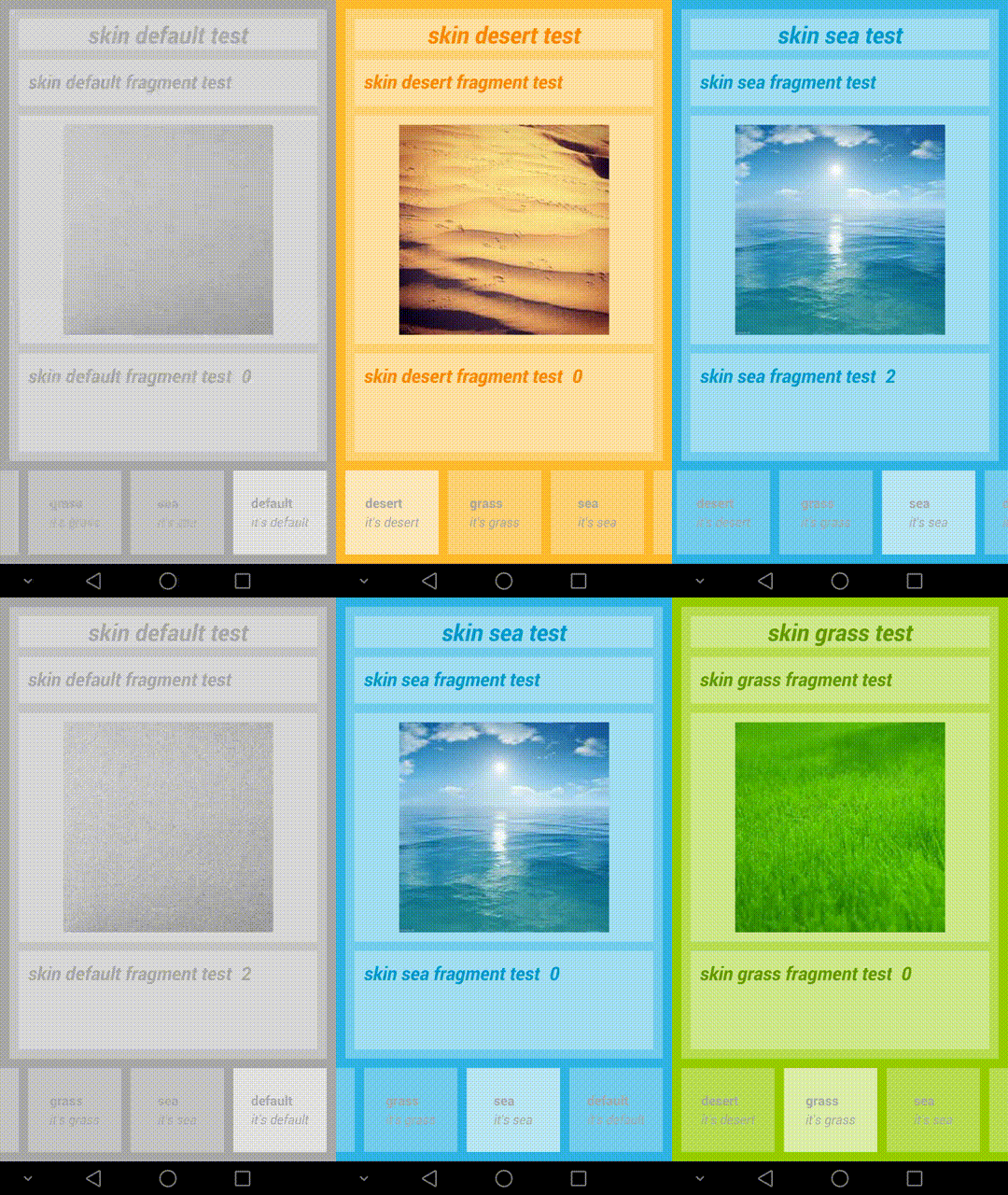
Skin apk contains ONLY resources, no codes. Make multiple skin apks of different skins by setting productFlavor.
// Skins used for demo, are DESERT (mostly orange color), GRASS(mostly green color) and SEA(mostly blue color).// Plus the default skin(mostly gray color), this demo contains 4 skins in total.
productFlavors {
desert {
}
grass {
}
sea {
}
}
Each skin apk contains no java codes, just resources for skin change:
task buildSkins(dependsOn: "assembleRelease") {

    delete fileTree(DEST_PATH) {
        include SKIN_APK_FILE_NAME_PATTERN
    }

    copy {
        from(FROM_PATH) {
            include SKIN_APK_FILE_NAME_PATTERN
        }
        into DEST_PATH
    }

}
In demo, this task makes 3 skin apks for 3 flavors. They are the skin packages. Their names are in the form of “skin_[SKIN_NAME]”. In demo, the gradle task makes skin_desert.apk, skin_grass.apk & skin_sea.apk. These apks are copied & pasted to the ASSET directory of the demo app. When in need of a skin change, framework loads skin apks from ASSET directory and apply them to the demo app, i.e. changing the skin.
(2) Activity should extend com.lilong.skinchange.base.SkinActivity
publicclassDemoActivityextendsSkinActivity {
....
(3) Fragment should extend com.lilong.skinchange.base.SkinFragment
publicclassDemoFragmentextendsSkinFragment {
...
(4) LayoutInflater needs to be acquired from getLayoutInflater() method of SkinActivity & SkinFragment. If system callbacks provide layoutInflater by params, it’s ok to use it.
...
// when making a FragmentPagerAdapter, the layoutInflater should be acquired by the getLayoutInflater() method in SkinActivity & SkinFragment.skinAdapter = newSkinTestFragmentPagerAdapter(getSupportFragmentManager(), getLayoutInflater());
...
The second param, rootView, is the root view of the SkinActivity or SkinFragment, which needs the skin change feature.
The third param, is the data structure needed by the skin change framework. This param can be acquired by getSkinizedAttributeEntries() method of SkinActivity.
The fourth param, is skin apk’s info. This param can be acquired by getCurSkinInfo() method of SkinManager, as the info of the current skin.
Tips: this API works only for the views in the viewTree under rootView. Different activities need their own calls to this API because their rootView are different.
The rootView of fragment will be added to the rootView of its host activity during fragment add process, so no need for calling this API in fragment. If an activity changes its skin, all the fragments under its management will change their skins too.
Theretically, all views which have user-defined id, and have attributes that use resouce references, are able to change their skin.
If the resouce name and type of certain attribute, are the same as a resource in the skin apk, the resource value will be changed to the one in skin apk. Then this change will be applied to the view by calling the setter of this view’s attributes, via reflection.
This is the idea of this framework.
For example, in project SkinChange,i.e. demo app, the root layout of DemoActivity is:
Its attribute “background”, referenced a resource, whose type is “color”, and name is “background”. In aforementioned skin_grass.apk, there’s also a resource with the same type and name:
Currently, the framework supports skin change of most attributes of View, TextView and ImageView. Other views and attributes can be taken into account by adding more reflection setter calls in
public static void applySkinizedAttribute(View v, String attributeName, Resources skinResources, int skinResId) method of com.lilong.skinchange.utils.SkinUtil.
If no apks whose name is in the form of “skin_[SKIN_NAME].apk”, appear in the ASSET directory of project SkinChange, demo app will use its default, mostly gray-color skin. This skin has no corresponding skin apk, because it’s just the assembly of initial resource values used by attributes.
/** * intercept activity content view's inflating process * when parsing layout xml, get each view's skinizable attributes and store them for future skin change */publicclassSkinViewFactoryimplementsLayoutInflater.Factory {
privatestaticfinalStringTAG = "SkinViewFactory";
privateSkinManagerskinManager;
/** * factory of system LayoutInflater, if not null, execute code of this default factory first * see if it returns a non-null view * this is for android support lib, e.g. FragmentActivity, who set its own factory in onCreate() */privateLayoutInflater.FactorydefaultFactory;
privateLayoutInflaterskinInflater;
/** * skinized attr map of this factory's inflater's enclosing activity */privateHashMap<String, ArrayList<SkinizedAttributeEntry>> skinizedAttrMapGlobal;
/** * a temporary skinizedAttrMap for immediate skin change when completing inflating this view */privateHashMap<String, ArrayList<SkinizedAttributeEntry>> skinizedAttrMapThisView;
publicSkinViewFactory(LayoutInflaterskinInflater, LayoutInflater.FactorydefaultFactory, HashMap<String, ArrayList<SkinizedAttributeEntry>> skinizedAttrMap) {
this.skinManager = SkinManager.getInstance(skinInflater.getContext());
this.skinInflater = skinInflater;
this.defaultFactory = defaultFactory;
this.skinizedAttrMapGlobal = skinizedAttrMap;
this.skinizedAttrMapThisView = newHashMap<String, ArrayList<SkinizedAttributeEntry>>();
}
@OverridepublicViewonCreateView(Stringname, Contextcontext, AttributeSetattrs) {
Viewv = null;
if (defaultFactory != null) {
v = defaultFactory.onCreateView(name, context, attrs);
}
try {
if (v == null) {
StringfullClassName = SkinUtil.getFullClassNameFromXmlTag(context, name, attrs);
Log.d(TAG, "fullClassName = " + fullClassName);
v = skinInflater.createView(fullClassName, null, attrs);
}
Log.d(TAG, v.getClass().getSimpleName() + "@" + v.hashCode());
ArrayList<SkinizedAttributeEntry> list = SkinUtil.generateSkinizedAttributeEntry(context, v, attrs);
for (SkinizedAttributeEntryentry : list) {
Log.d(TAG, entry.getViewAttrName() + " = @" + entry.getResourceTypeName() + "https://github.com/" + entry.getResourceEntryName());
// use attribute type and entry name as key, to identify a skinizable attributeStringkey = entry.getResourceTypeName() + "https://github.com/" + entry.getResourceEntryName();
skinizedAttrMapThisView.clear();
if (skinizedAttrMapThisView.containsKey(key)) {
skinizedAttrMapThisView.get(key).add(entry);
} else {
ArrayList<SkinizedAttributeEntry> l = newArrayList<SkinizedAttributeEntry>();
l.add(entry);
skinizedAttrMapThisView.put(key, l);
}
// immediate skin change of this viewSkinUtil.changeSkin(skinInflater.getContext(), v, skinizedAttrMapThisView, skinManager.getCurSkinInfo());
// meanwhile add these skinized attr entries to the global map for future skin changeif (skinizedAttrMapGlobal.containsKey(key)) {
skinizedAttrMapGlobal.get(key).add(entry);
} else {
ArrayList<SkinizedAttributeEntry> l = newArrayList<SkinizedAttributeEntry>();
l.add(entry);
skinizedAttrMapGlobal.put(key, l);
}
}
} catch (ClassNotFoundExceptione) {
Log.e(TAG, Log.getStackTraceString(e));
}
returnv;
}
}
A skinizable attribute is recorded as an SkinizedAttributeEntry. One skinizable attribute of one view can be recorded as such a SkinizedAttributeEntry.
The hashmap of complete attribute name : skinizable attributes, is HashMap<String, ArrayList<SkinizedAttributeEntry>>.
The complete attribute name, i.e. the key of this map, is a string in the form of “[RESOURCE_TYPE]/[RESOURCE_NAME]”.
The skinizable attributes, i.e. the value of this map, are all the attributes which reference such a resource, recorded by SkinViewFactory during the inflation interception. For example, there’s a TextView:
This view leads to two keys, “string/tv_title_frag” and “color/tv_title_frag”, their corresponding value is a one-element ArrayList. “string/tv_title_frag”‘s list contains one skinizedAttributeEntry,which contains a reference to this TextView,attribute name “text”,resource type “string” and resource name “tv_title_frag”. “color/tv_title_frag”‘s list contains one skinizedAttributeEntry,which contains a refrence to this TextView,attribute name “textColor”,resource type”color” and resource name “tv_title_frag”.
Each SkinActivity/SkinFragmentActivity owns such a skinizedAttrMap,serving as a matching dictionary between app and skin apk.
Parse skin apk, record all the resources it contains
/** * use DexClassLoader to get all resource entries in a specified apk * dynamic load this apk, no need to install it * in this senario, "a specified apk" refers to the skin apk * * @param hostClassLoader main application's classloader * @param apkPath absolute path of this specified apk * @return a list of all the resource entries in the specified apk */publicstaticArrayList<ResourceEntry> getSkinApkResourceEntries(Contextcontext, ClassLoaderhostClassLoader, StringapkPath) {
ArrayList<ResourceEntry> list = newArrayList<ResourceEntry>();
try {
// odex path of the specified apk is main application's FILES dirDexClassLoaderdexClassLoader = newDexClassLoader(apkPath, context.getFilesDir().getAbsolutePath(), null, hostClassLoader);
StringpackageName = getPackageNameOfApk(context.getPackageManager(), apkPath);
// get all member classes of R.java, i.e. all resource types in this packageClass[] memberClassArray = loadMemberClasses(dexClassLoader, packageName + ".R");
for (Classc : memberClassArray) {
// get all int type declared fields, i.e. all resource entries in this resource typefor (FieldentryField : c.getDeclaredFields()) {
if ("int".equals(entryField.getType().getSimpleName())) {
ResourceEntrye = newResourceEntry(packageName, c.getSimpleName(), entryField.getName(), entryField.getInt(null));
list.add(e);
}
}
}
} catch (Exceptione) {
Log.e(TAG, Log.getStackTraceString(e));
}
returnlist;
}
A resource is recorded as a ResourceEntry, which contains resource type, resource name, and resource id. These information is acquired by parsing R.java of skin apk via reflection. When finish parsing the resources in a skin apk, the framework returns a list of the resources this apk contains. This is a list of ResourceEntry.
/** * change skin using a specified skin apk * * @param rootView rootView of android activity/fragment who is using skin change feature * @param skinizedAttrMap hashmap * key is a skinized attribute identifier, formed as "resource typename/resource entryname" * value is a list, contains all views that have this kind of skinized attribute * each ownership relation is a skinizedAttributeEntry * @param resourceEntries contains resource entries which are used to match against app's skinized attributes * @param fromResources matched resource entry will get actual resource value from this resources instance */publicstaticvoidchangeSkinByResourceEntries(ViewrootView, HashMap<String, ArrayList<SkinizedAttributeEntry>> skinizedAttrMap, ArrayList<ResourceEntry> resourceEntries, ResourcesfromResources) {
for (ResourceEntryentry : resourceEntries) {
Stringkey = entry.getTypeName() + "https://github.com/" + entry.getEntryName();
if (skinizedAttrMap.containsKey(key)) {
ArrayList<SkinizedAttributeEntry> l = skinizedAttrMap.get(key);
for (SkinizedAttributeEntrye : l) {
Viewv = e.getViewRef().get();
//TODO duplicate id within the same view tree is a problem// e.g. when fragment's layout has a child view with the same id as the parent viewif (v == null) {
v = rootView.findViewById(e.getViewId());
}
if (v == null) {
continue;
}
SkinUtil.applySkinizedAttribute(v, e.getViewAttrName(), fromResources, entry.getResId());
}
}
}
}
Traverse the resourceEntries in skin apk, compare the resource type and name against skinizable resources, i.e. the SkinizedAttributeEntry list. If there’s a match, extract the view reference and id from SkinizedAttributeEntry, thus getting the view, then fetch the resource value from skin apk. Based on the attribute name in SkinizedAttributeEntry and the aforementioned information, call the attribute setter of this view via reflection, changing the skin.
Change skin by search result, by calling setter via reflection
/** * reset view's attribute due to skin change * * @param v view whose attribute is to be reset due to skin change * @param attributeName name of the attribute * @param skinResources Resources instance of the skin apk * @param skinResId new attribute's value's resId within Resources instance of the skin apk */publicstaticvoidapplySkinizedAttribute(Viewv, StringattributeName, ResourcesskinResources, intskinResId) {
// android.view.Viewif ("layout_width".equals(attributeName)) {
// only workable when layout_width attribute in xml is a precise dimenViewGroup.LayoutParamslp = v.getLayoutParams();
lp.width = (int) skinResources.getDimension(skinResId);
v.setLayoutParams(lp);
} elseif ("layout_height".equals(attributeName)) {
// only workable when layout_height attribute in xml is a precise dimenViewGroup.LayoutParamslp = v.getLayoutParams();
lp.height = (int) skinResources.getDimension(skinResId);
v.setLayoutParams(lp);
} elseif ("background".equals(attributeName)) {
DrawablebackgroundDrawable = skinResources.getDrawable(skinResId);
v.setBackgroundDrawable(backgroundDrawable);
} elseif ("alpha".equals(attributeName)) {
floatalpha = skinResources.getFraction(skinResId, 1, 1);
v.setAlpha(alpha);
} elseif ("padding".equals(attributeName)) {
intpadding = (int) skinResources.getDimension(skinResId);
v.setPadding(padding, padding, padding, padding);
} elseif ("paddingLeft".equals(attributeName)) {
intpaddingLeft = (int) skinResources.getDimension(skinResId);
v.setPadding(paddingLeft, v.getPaddingTop(), v.getPaddingRight(), v.getPaddingBottom());
} elseif ("paddingTop".equals(attributeName)) {
intpaddingTop = (int) skinResources.getDimension(skinResId);
v.setPadding(v.getPaddingLeft(), paddingTop, v.getPaddingRight(), v.getPaddingBottom());
} elseif ("paddingRight".equals(attributeName)) {
intpaddingRight = (int) skinResources.getDimension(skinResId);
v.setPadding(v.getPaddingLeft(), v.getPaddingTop(), paddingRight, v.getPaddingBottom());
} elseif ("paddingBottom".equals(attributeName)) {
intpaddingBottom = (int) skinResources.getDimension(skinResId);
v.setPadding(v.getPaddingLeft(), v.
......
Based on view, name of the skinizable attribute, Resources instance of the skin apk, resource id, the framework calls view’s setter to change attribute, thus changing skin.
/** * change skin using a specified skin apk * this apk can be a skin apk, OR this app itself(restore to default skin) * * @param rootView rootView of android activity/fragment who is using skin change feature * @param skinizedAttrMap hashmap * key is a skinized attribute identifier, formed as "resource typename/resource entryname" * value is a list, contains all views that have this kind of skinized attribute * each ownership relation is a skinizedAttributeEntry * @param info skinInfo which contains the target skin's information */publicstaticvoidchangeSkin(Contextcontext, ViewrootView, HashMap<String, ArrayList<SkinizedAttributeEntry>> skinizedAttrMap, SkinInfoinfo) {
ArrayList<ResourceEntry> resourceEntries = null;
Resourcesresources = null;
// restore to default skinif (info.isSelf()) {
// parse R.java file of THIS APP's apk, get all attributes and their values(references) in itresourceEntries = SkinUtil.getThisAppResourceEntries(context);
// resources instance from this appresources = context.getResources();
}
// change skin according to skin apkelse {
// parse R.java file of skin apk, get all attributes and their values(references) in itresourceEntries = SkinUtil.getSkinApkResourceEntries(context, context.getClassLoader(), info.getSkinApkPath());
// get Resources instance of skin apkresources = SkinUtil.getApkResources(context.getResources(), info.getSkinApkPath());
}
changeSkinByResourceEntries(rootView, skinizedAttrMap, resourceEntries, resources);
}
Enhances Kirby’s css() and js() helpers to support hashed filenames. Pass your normal paths (e.g. …main.js) – the plugin will lookup hashed assets and transform the path automatically (e.g. …main.20201226.js). That way you can even keep asset paths identical in development and production environment!
For file hashing this plugin uses the hashup npm package.
hashup is a tiny CLI tool with two objectives in mind for your freshly build assets:
Rename or rather hash (hence the name) the assets.
Generate a manifest.json for them.
You don’t even have to install it to your devDependencies, since npx will fetch it once on the fly. Add hashup to your build pipeline by adding it your package.json scripts (recommended), for example:
If no template file exists, https://example.com/@template will be echoed. This will lead to HTTP errors and blocked content since the requested file doesn’t exist and the error page’s HTML will be returned.
If you are unsure if a template file exists, use the following helpers:
cssTpl()
jsTpl()
They will echo a link tag, respectively script tag, only if a template file for current page’s template is present.
Manual Hashing
For smaller websites you may prefer no build chain at all, but still want to utilize some form of asset hashing. In this use-case you can rename your files manually.
Take an imaginary main.js for example. Just include it like you normally would in one of your snippets:
Voilà, without changing the asset path the hashed file will be found and rendered in your template!
Hashed Filenames for Preloading Links
You can use the global hashedUrl() helper to lookup a file like you normally would with the css() or js() helpers. While the latter return a link or respectively script tag, the hashedUrl() helper will only return a URL which you can use in any context.
This project implements automation tests for the Selenium Web Form page using Behave (a BDD testing framework for Python), Selenium WebDriver and Allure Reports to create detailed performance reports.
📝 Objective
The goal of this project is to demonstrate how to use Behave and Selenium WebDriver to create and execute automated tests based on scenarios described in the Gherkin language.
The main code resides in the Behave step definition file, which connects the scenarios described in Gherkin files to Python code.
📝 Step File Organization
Here’s the information organized in a table format:
Feature File
Description of Scenarios
Step File
Step Definitions Purpose
webform_actions_part_1.feature
Scenarios for text, password, and textarea inputs.
webform_actions_part_1.py
Contains step definitions for handling input scenarios.
webform_actions_part_2.feature
Scenarios for dropdown boxes.
webform_actions_part_2.py
Contains step definitions for handling dropdown scenarios.
webform_actions_part_3.feature
Scenarios for file input, checkbox and radio buttons.
webform_actions_part_3.py
Contains step definitions for handling file input and buttons scenarios.
webform_actions_part_4.feature
Scenarios for color, date picker and range bar.
webform_actions_part_4.py
Contains step definitions for handling color, date picker and range bar scenarios.
It includes three main steps:
Given: Opens the web form page.
When: Enters text into the input field.
Then: Clicks the submit button.
@given(u'the browser open Webform page')@when(u'insert a information in the text input field')@then(u'the submit button will be clicked')
Example Gherkin Scenario
An example of how a scenario can be described in Gherkin in the features/form_test.feature file:
Feature: Test the Selenium Web FormScenario: Fill and submit the formGiven the browser open Webform page
When insert a information in the text input field
Then the submit button will be clicked
Make sure the requirements.txt file includes the following dependencies:
behave
selenium
Install the WebDriver for your browser (e.g., ChromeDriver for Google Chrome). Ensure the driver is added to your system PATH.
▶️ Running the Tests
To run the tests, use the following command:
behave
This will execute all scenarios described in the .feature files within the features directory.
🗒️ Generating Allure Reports
Install AlLure:
Allure can be installed in various ways. Choose the method that best fits your environment:
Option 1: Use the Allure Commandline
Via Homebrew (macOS/Linux):
brew install allure
Via Chocolatey (Windows):
First, install Chocolatey. Then:
choco install allure
Via Binary (manual):
Download the zip file from Allure Releases.
Extract the contents and add the binary directory to your PATH.
Install Allure plugin for Python:
Install the allure-behave package, which integrates Allure with Behave.
pip install allure-behave
Set up project for Allure
Make sure Behave test results are generated in a format compatible with Allure:
Run Behave with the Allure Plugin: When running your Behave tests, include the -f allure_behave.formatter:AllureFormatter option to use the Allure format and -o allure-results to specify the output directory for the results.
I actually started learning CUDA for GPGPU first, but since I do
my work with a MacBook Air (late 2012 model); I quickly realized
I couldn’t run CUDA code. My machine has an Intel HD Graphics 4000, I know, it sucks,
but still usuable! My search on how to best make use of it led me to OpenCL.
My interests with OpenCL is primarly motivated by my interests in Deep Learning.
I want a better understanding of how these frameworks are making use
of GPGPU to blaze through model training.
Here we are now, a repo of OpenCL examples. I’ll be adding more
examples here as I pickup more of OpenCL. I am thinking each example will
get a bit more complex.
Setup I am using
Mac OSX
OpenCL 1.2
C++ 11
cmake 3.7
How to Build and Run
Clone this repo and cd in this repo.
Run mkdir build && cd build
Run cmake .. && make
If everything has been correctly installed, you should be able to build
the examples with no problems. Check out the CMakeLists.txt file for info
on how the examples are being built.
Note, I already added the C++ header for OpenCL 1.x in the libs directory.
However, if you are for example working with OpenCL 2 you can create your own
header file. Head over to the KhronosGroup OpenCL-CLHPP repo
and do the following.
Run git clone https://github.com/KhronosGroup/OpenCL-CLHPP
Run cd OpenCL-CLHPP
Run python gen_cl_hpp.py -i input_cl2.hpp -o cl2.hpp
Move the generated header file cl2.hpp into the libs directory.
Profit!
Quick Introduction and OpenCL Terminology
You’re here so I don’t need to convince you that parallel computing is awesome
and the future. I don’t expect you to become an expert after you’ve gone through this repo,
but I do hope you at least get an overview of how to think in OpenCL.
OpenCL™ (Open Computing Language) is the open,
royalty-free standard for cross-platform,
parallel programming of diverse processors
found in personal computers, servers,
mobile devices and embedded platforms. – khronos site
The following are terms to know:
Platform: Vendor specific OpenCL implementation.
Host: The client code that is running on the CPU. Basically your application.
Device: The physical devices you have that support OpenCL (CPU/GPU/FPGA etc..)
Context: Devices you select to work together.
Kernel: The function that is run on the device and does the work.
Work Item: A unit of work that executes a kernel.
Work Group: A collection of work items.
Command Queue: The only way to tell a device what to do.
Buffer: A chunk of memory on the device.
Memory: Can be global/local/private/constant (more on this later.)
This repository provides a Docker-based tool for generating resident SSH keys using a YubiKey. Resident keys allow secure SSH authentication without needing to store the private key on disk.
What is a Resident SSH Key?
A resident SSH key is a key pair stored directly on a FIDO2-compatible YubiKey. Unlike traditional SSH keys, the private key never leaves the YubiKey, and only a reference to the key is needed on the host machine. This makes it more secure and convenient, especially when switching devices, as you can restore the key reference at any time.
Features
Generates resident SSH keys that are stored directly on the YubiKey.
Automatic key regeneration (restore keys anytime using ssh-keygen -K).
Uses Docker to provide an isolated and repeatable environment.
Supports optional UID tagging for managing multiple resident keys.
Prerequisites
A YubiKey 5 Series or compatible FIDO2 security key.
Docker and Docker Compose installed on your system.
OpenSSH 8.2+ (for FIDO2 SSH key support).
Setup
Clone this repository and navigate into the project directory:
git clone https://github.com/your-username/yubikey-resident.git
cd yubikey-resident
Usage
To generate a new resident SSH key, run:
docker compose run --rm keygen
This will:
Prompt for an optional key comment.
Display existing resident keys stored on the YubiKey.
Prompt for an optional UID (to manage multiple keys).
Generate a new SSH key stored directly on your YubiKey.
Optionally drop you into a bash shell for further management.
How Reference Files Are Stored
When generating a new resident SSH key, the reference files are automatically saved into the ssh_keys/ folder (mapped to /root/.ssh in the container). These files include:
id_ed25519_sk – A reference file pointing to the private key stored on the YubiKey. If a UID was provided, the filename will be formatted as id_ed25519_sk_<UID>.
id_ed25519_sk.pub – The public key file used for SSH authentication.
Since the actual private key never leaves the YubiKey, these reference files are simply used to interact with the key stored on the device. If deleted, they can always be regenerated using:
ssh-keygen -K
Restoring SSH Keys
If you lose the reference files (id_ed25519_sk and id_ed25519_sk.pub), you can restore them using:
ssh-keygen -K
This will retrieve all resident keys from your YubiKey.
Listing Stored Keys
To check what resident keys are stored on your YubiKey, run:
ykman fido credentials list
This will show all stored keys, including any UIDs you assigned during key generation.
Using SSH with Your YubiKey
Once the key is generated and restored, you can use it for SSH authentication:
ssh -i ~/.ssh/id_ed25519_sk user@server.com
If a UID was used, the correct filename should be specified, e.g.:
ssh -i ~/.ssh/id_ed25519_sk_<UID> user@server.com
Security Considerations
✅ Private keys never leave the YubiKey (unlike standard SSH keys).
✅ No need to store sensitive key files.
✅ Even if your local reference file is deleted, you can restore it anytime.
❌ You must have access to the same YubiKey and remember your PIN to recover your resident key.
Repository Structure
├── Dockerfile         # Sets up the container with OpenSSH and YubiKey Manager
├── docker-compose.yml # Defines the Docker service for key generation
├── keygen.sh          # The main script to generate resident keys
└── README.md          # This documentation
Contributing
Feel free to open an issue or submit a pull request if you’d like to improve this project!
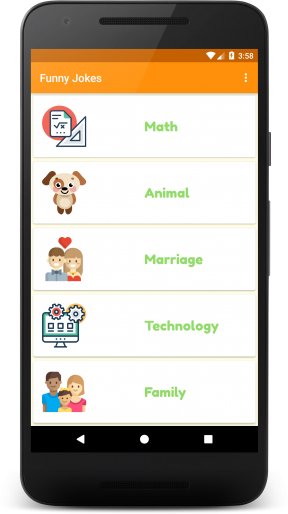
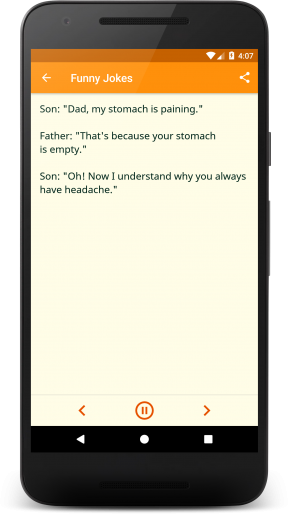
In this project, you will create an app with multiple flavors that uses
multiple libraries and Google Cloud Endpoints. The finished app will consist
of four modules. A Java library that provides jokes, a Google Cloud Endpoints
(GCE) project that serves those jokes, an Android Library containing an
activity for displaying jokes, and an Android app that fetches jokes from the
GCE module and passes them to the Android Library for display.
Why this Project
As Android projects grow in complexity, it becomes necessary to customize the
behavior of the Gradle build tool, allowing automation of repetitive tasks.
Particularly, factoring functionality into libraries and creating product
flavors allow for much bigger projects with minimal added complexity.
What Will I Learn?
You will learn the role of Gradle in building Android Apps and how to use
Gradle to manage apps of increasing complexity. You’ll learn to:
Add free and paid flavors to an app, and set up your build to share code between them
Factor reusable functionality into a Java library
Factor reusable Android functionality into an Android library
Configure a multi project build to compile your libraries and app
Use the Gradle App Engine plugin to deploy a backend
Configure an integration test suite that runs against the local App Engine development server
Video
I’ve created a video demonstrating the app. Click here to view the video on YouTube.
This is the starting point for the final project, which is provided to you in
the course repository. It
contains an activity with a banner ad and a button that purports to tell a
joke, but actually just complains. The banner ad was set up following the
instructions here:
You may need to download the Google Repository from the Extras section of the
Android SDK Manager.
You will also notice a folder called backend in the starter code.
It will be used in step 3 below, and you do not need to worry about it for now.
When you can build an deploy this starter code to an emulator, you’re ready to
move on.
Step 1: Create a Java library
Your first task is to create a Java library that provides jokes. Create a new
Gradle Java project either using the Android Studio wizard, or by hand. Then
introduce a project dependency between your app and the new Java Library. If
you need review, check out demo 4.01 from the course code.
Make the button display a toast showing a joke retrieved from your Java joke
telling library.
Step 2: Create an Android Library
Create an Android Library containing an Activity that will display a joke
passed to it as an intent extra. Wire up project dependencies so that the
button can now pass the joke from the Java Library to the Android Library.
For review on how to create an Android library, check out demo 4.03. For a
refresher on intent extras, check out;
This next task will be pretty tricky. Instead of pulling jokes directly from
our Java library, we’ll set up a Google Cloud Endpoints development server,
and pull our jokes from there. The starter code already includes the GCE module
in the folder called backend.
Before going ahead you will need to be able to run a local instance of the GCE
server. In order to do that you will have to install the Cloud SDK:
Note: You do not need to follow the rest of steps in the migration guide, only
the Setup Cloud SDK.
Start or stop your local server by using the gradle tasks as shown in the following
screenshot:
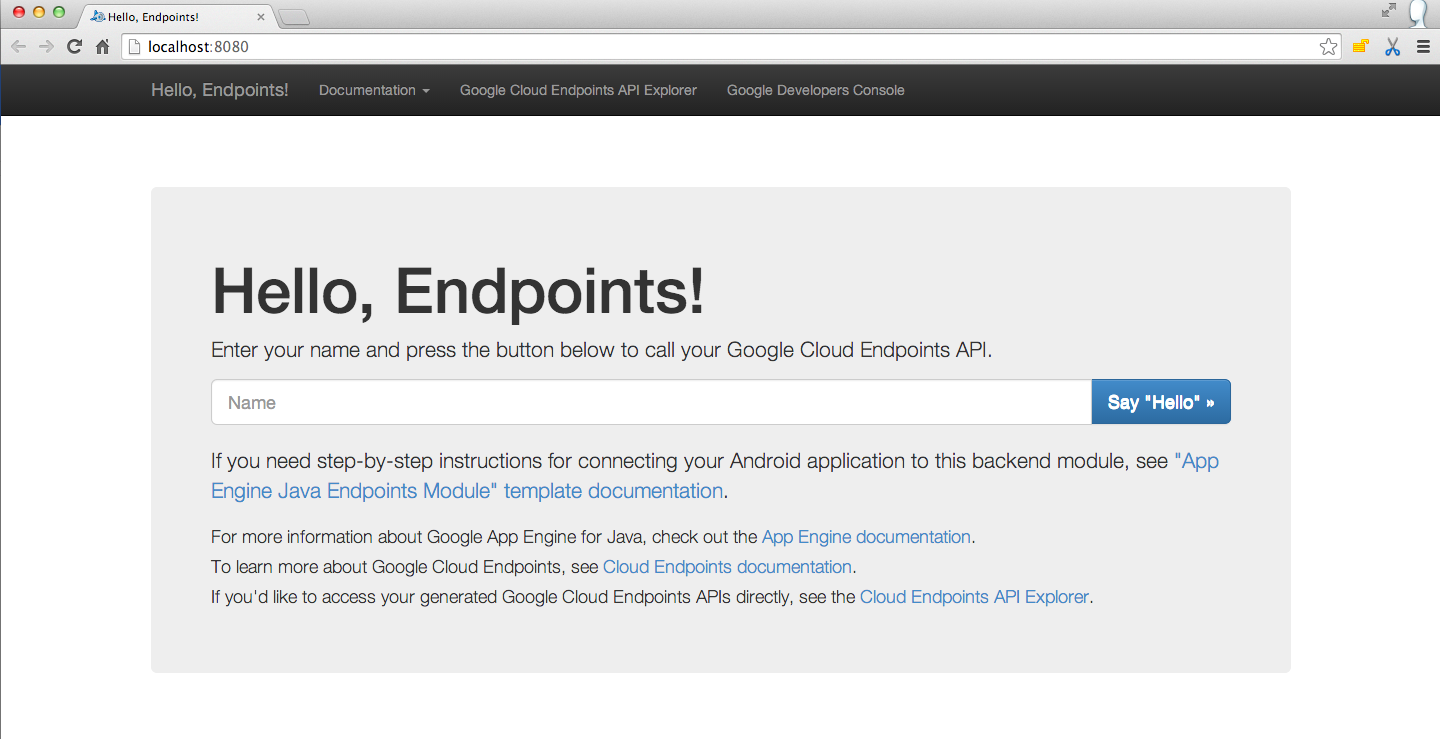
Once your local GCE server is started you should see the following at
localhost:8080
Now you are ready to continue!
Introduce a project dependency between your Java library
and your GCE module, and modify the GCE starter code to pull jokes from your Java library.
Create an AsyncTask to retrieve jokes using the template included int these
instructions.
Make the button kick off a task to retrieve a joke,
then launch the activity from your Android Library to display it.
Step 4: Add Functional Tests
Add code to test that your Async task successfully retrieves a non-empty
string. For a refresher on setting up Android tests, check out demo 4.09.
Step 5: Add a Paid Flavor
Add free and paid product flavors to your app. Remove the ad (and any
dependencies you can) from the paid flavor.
Optional Tasks
For extra practice to make your project stand out, complete the following tasks.
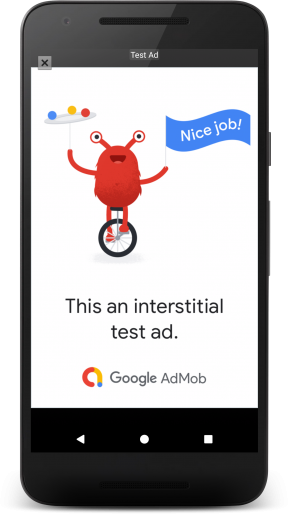
Add Interstitial Ad
Follow these instructions to add an interstitial ad to the free version.
Display the ad after the user hits the button, but before the joke is shown.
Add a loading indicator that is shown while the joke is being retrieved and
disappears when the joke is ready. The following tutorial is a good place to
start:
GitHub’s Watch feature doesn’t send notifications when commits are pushed.
This script aims to implement this feature and much more.
Call for maintainers: I don’t use this project myself anymore but IFTTT
instead (see below). If you’re interested in taking over the maintenance of
this project, or just helping, please let me know (e.g. by opening an issue).
That’s it. As long as your machine is running you’ll get e-mails when something gets pushed on a repo you’re watching.
NOTES:
The e-mails are likely to be considered as spam until you mark one as
non-spam in your e-mail client. Or use the --mailfrom option.
If you’re watching 15 repos or more, you probably want to use the --credentials option to make sure you don’t hit the GitHub API rate limit.
Other/Advanced usage
gicowa is a generic command-line tool with which you can make much more that
just implementing the use case depicted in the introduction. This section
shows what it can.
$ gicowa lastrepocommits AurelienLourot/github-commit-watcher since 2015 07 05 09 12 00
lastrepocommits AurelienLourot/github-commit-watcher since 2015-07-05 09:12:00
Last commit pushed on 2015-07-05 10:48:58
Committed on 2015-07-05 10:46:27 - Aurelien Lourot - Minor cleanup.
Committed on 2015-07-05 09:39:01 - Aurelien Lourot - watchlist command implemented.
Committed on 2015-07-05 09:12:00 - Aurelien Lourot - argparse added.
NOTES:
Keep in mind that a commit’s committer timestamp isn’t the time at
which it gets pushed.
The lines starting with Committed on list commits on the master
branch only. Their timestamps are the committer timestamps.
The line starting with Last commit pushed on shows the time at which a
commit got pushed on the repository for the last time on any branch.
List last commits on repos watched by a user
$ gicowa lastwatchedcommits AurelienLourot since 2015 07 04 00 00 00
lastwatchedcommits AurelienLourot since 2015-07-04 00:00:00
AurelienLourot/crouton-emacs-conf - Last commit pushed on 2015-07-04 17:10:18
AurelienLourot/crouton-emacs-conf - Committed on 2015-07-04 17:08:48 - Aurelien Lourot - Support for Del key.
brillout/FasterWeb - Last commit pushed on 2015-07-04 16:40:54
brillout/FasterWeb - Committed on 2015-07-04 16:38:55 - brillout - add README
AurelienLourot/github-commit-watcher - Last commit pushed on 2015-07-05 10:48:58
AurelienLourot/github-commit-watcher - Committed on 2015-07-05 10:46:27 - Aurelien Lourot - Minor cleanup.
AurelienLourot/github-commit-watcher - Committed on 2015-07-05 09:39:01 - Aurelien Lourot - watchlist command implemented.
AurelienLourot/github-commit-watcher - Committed on 2015-07-05 09:12:00 - Aurelien Lourot - argparse added.
AurelienLourot/github-commit-watcher - Committed on 2015-07-05 09:07:14 - AurelienLourot - Initial commit
NOTE: if you’re watching 15 repos or more, you probably want to use the --credentials option to make sure you don’t hit the GitHub API rate limit.
List last commits since last run
Any listing command taking a since <timestamp> argument takes also a sincelast one. It will then use the time where that same command has been
run for the last time on that machine with the option --persist. This option
makes gicowa remember the last execution time of each command in ~/.gicowa.